

INDEPENDENT TECHNICAL JUDGEMENT FOR EARLY STAGE DIAGNOSTICS
Turn Early Assay Science into Development and Investment Readiness.
ORIVISE helps diagnostics founders, research teams and investors assess assay feasibility, expose hidden technical risks and strengthen the evidence needed for confident development, funding and investment decisions.
The ORIVISE Translation Layer
ORIVISE sits between early scientific promise and critical development, funding and commercial decisions — translating assay data into clearer technical judgement.
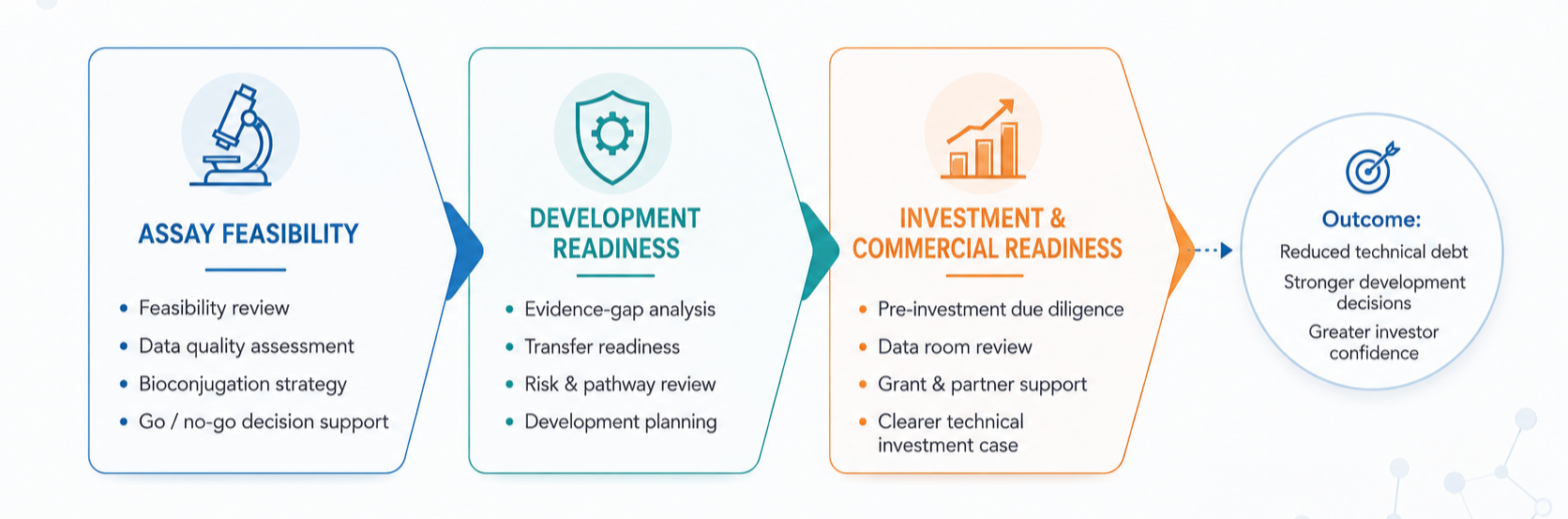
The Early Decisions That Determine Development Success
Most early-stage IVD programmes do not fail because teams lack scientific capability. They fail because feasibility data, assay architecture and development assumptions are not tested against a clear decision framework early enough.
These decisions typically centre on three critical areas:
Development Readiness
Is the evidence strong enough to support regulated development, scale-up or partner engagement?
Scalability & Transfer
Will the assay architecture translate into reproducible performance beyond early lab conditions?
Technical Risk
What hidden assay, reagent or performance risks could delay development, funding or transfer?
Who We Support at Critical Development Decisions

Early-stage IVD Startups & Founders
Validate assay feasibility, identify hidden risks and define the next technical decision before committing further runway.

VCs, Angels & Investment Partners
Independent pre-investment technical due diligence and data room review for early-stage diagnostic opportunities.

Academic Labs, Biohubs & University Spin-Outs
Technical and commercialisation input for grant-led translation, feasibility planning and development-readiness.

R&D & Innovation Teams
Independent review of persistent assay, reagent or development challenges when internal teams need an external technical lens.
Working on an early-stage IVD programme?
How ORIVISE Turns Technical Uncertainty into Clear Decisions
ORIVISE provides independent technical assessment to evaluate feasibility, identify hidden risks, and define the critical path forward.
Define the Decision
Clarify the funding, development, transfer or feasibility decision the data must support.
Review Existing Evidence
Assess assay data, assumptions, architecture, reagent strategy and performance claims.
Identify Risks and Gaps
Surface hidden technical risks, missing evidence and potential sources of future rework.
Assess Readiness
Evaluate whether the programme is feasible, development-ready, investor-ready or requires refinement.
Recommend Next Steps
Provide clear, prioritised actions aligned to technical, commercial and funding decisions.
Flexible Ways to Engage
Feasibility & Technical Risk Review
Structured review of assay feasibility, technical risks, data quality and decision-critical gaps.
Troubleshooting & Bioconjugation Strategy
Root-cause review of assay variability, reagent instability, performance drift or bioconjugation-related issues.
Development Readiness Assessment
Assessment of whether the assay, evidence and technical plan are ready for regulated development, scale-up or transfer.
Pre-Investment Technical Due Diligence
Independent review of assay claims, data room evidence, feasibility risk and technical credibility before investment decisions.
Not Sure Which Option Fits?
Example Outcome
Resolving Variability in an Early-Stage Immunoassay
Challenge:
An early-stage immunoassay was showing high variability and poor reproducibility, creating uncertainty around progression into structured development.
Technical Insight:
Independent review identified the bioconjugation strategy as a likely contributor to instability and inconsistent assay behaviour.
Outcome:
Improved reproducibility, stabilised assay performance and a clearer path toward development-readiness.
ORIVISE is led by Dr. Pompi Hazarika, who brings 20+ years of experience across the UK, Germany and India, including senior leadership in IVD feasibility, assay development and new product development within regulated diagnostics organisations.
PhD, Germany | IIT, India | Executive MBA Candidate, UK
ORIVISE combines deep diagnostics R&D expertise with commercial and strategic thinking to support critical development, funding and investment decisions.
Ready to Make a Clearer Technical Decision?
Get independent technical input to assess feasibility, identify risks, and define the right next step before committing development effort or capital.
We'll respond within 2 business days. Initial discussion is confidential and without obligation.