
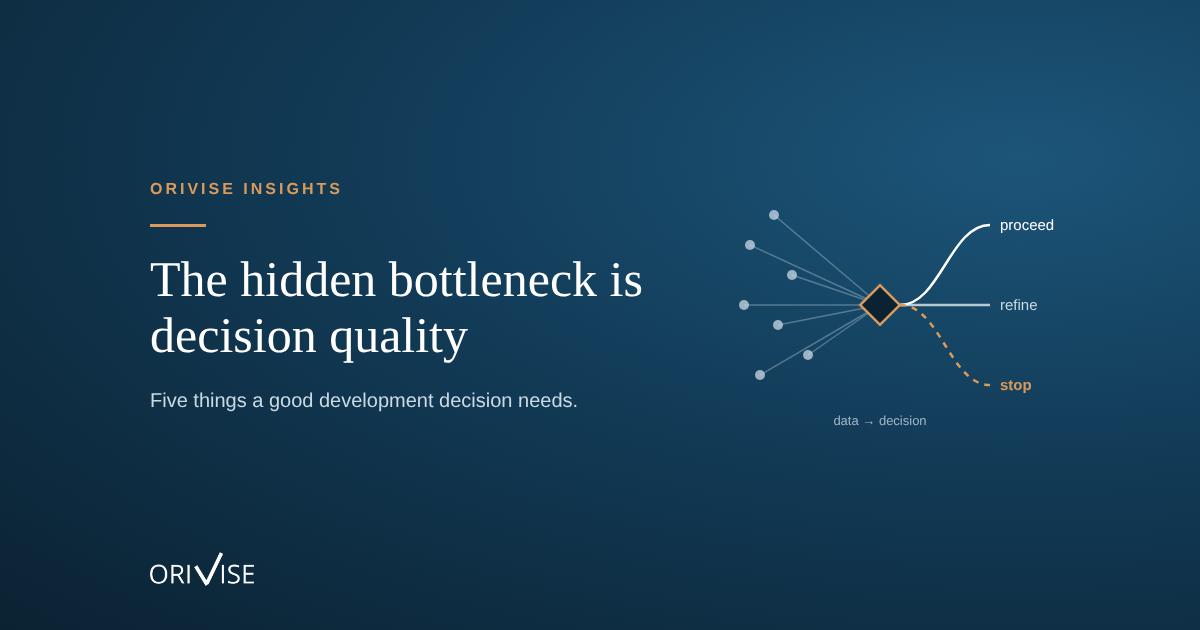
Diagnostics projects rarely stall because nobody ran enough experiments. More often, they stall because the experiments that were run did not lead to a clear decision. Data accumulates, timelines move, and the same questions return at the next review.
The bottleneck is often decision quality: what to test, what the result means, and what happens next.
What weak decisions look like at the bench
Several variables change at once. A new buffer, a new conjugate lot and a revised incubation time go into the same run. The result improves or worsens, but nobody can say why.
One factor at a time when factors interact. Each parameter is optimised separately, so interactions, for example between antibody concentration and blocking conditions, are missed until later.
Acceptance criteria are set after the data arrives. Without a target written down in advance, “good enough” is decided after the result, and borderline data becomes easy to accept.
Known issues are carried forward. Lot-to-lot variation, matrix effects or stability questions are noted, then deferred to the next phase, where they are harder and more expensive to resolve.
More experiments instead of a decision. When the evidence is ambiguous, repeating the study can feel safer than deciding. It often only delays the point at which the real question has to be faced.
These problems are not usually caused by poor science. They are more often caused by time pressure, unclear ownership or an experiment that was never tied to a specific decision.
What a good development decision needs
A defined question: what the experiment needs to show, and which decision depends on it.
Criteria agreed in advance: what result would mean proceed, refine or stop.
An experiment designed to discriminate between explanations: the right controls, samples, replication and variables to separate the causes that matter.
Ranked uncertainties: not every open question matters equally. The ones that could change the decision come first.
A clear owner: someone accountable for making the call and recording the rationale.
Why it matters later
Decisions made early in development shape what becomes expensive later. An assumption accepted during feasibility becomes a design input. An unresolved variable becomes a transfer issue. A deferred stability question becomes a timeline problem.
Better decisions do not remove uncertainty, but they make it visible while it is still affordable to address.
Questions to ask before your next development gate
What decision is this gate actually asking us to make?
Were the acceptance criteria written down before the data was generated?
Can the key results be explained by one variable, or were several changed together?
Which open issues are we carrying forward, and what would they cost to resolve later?
Who owns the decision, and is the rationale recorded?
If your team is facing a development decision and wants an independent view of what the evidence supports, contact ORIVISE for a free intro call.
This article is for general technical discussion and is not a substitute for a product-specific assessment.
