
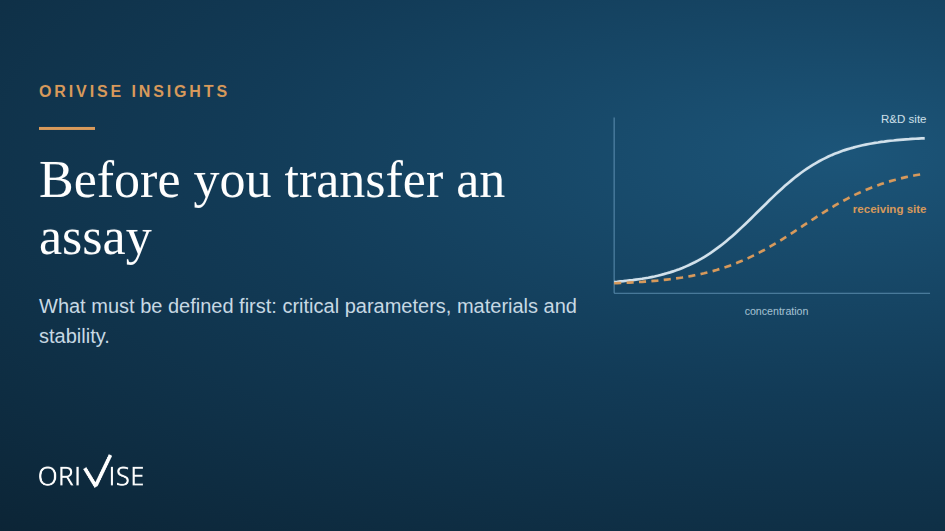
Transferring an assay to a development partner, CDMO or manufacturing site is one of the more expensive decision points in diagnostics development. It is also where gaps from earlier work tend to surface. An assay that performs well in the team that built it can drift when the people, equipment, materials and documents change.
Most transfer problems are not new problems. They are unanswered questions carried forward from development.
Three signs an assay is not ready to transfer
Critical parameters are known informally, not defined. The original team knows which incubation time, wash step or reagent ratio matters, but the method does not state acceptable ranges.
Reproducibility has only been shown in one setting. Data comes from one lab, a few operators and one or two reagent lots.
Stability evidence is thin. There is not yet enough data on reagents, calibrators or the finished assay to support the shelf life and storage the partner will need.
What a readiness review should cover
Reproducibility: performance across operators, days, instruments and reagent lots, with variation measured, not assumed.
Critical parameters: which variables affect performance, their acceptable ranges, and the evidence behind them.
Critical materials: specifications, suppliers and lot-to-lot behaviour for antibodies, antigens, conjugates and other key reagents.
Stability: what data exists, what is still needed, and whether it supports the transfer timeline.
Documentation: design inputs, risk analysis and methods in a form the receiving team can use, with ISO 13485 and IVDR expectations in view.
The cost of finding gaps late
Gaps found before transfer are usually closed with focused experiments and clearer documents. Gaps found after transfer often mean repeated characterisation, delays at the receiving site, disputed results and sometimes redevelopment. The same question costs far more to answer once another organisation is waiting on it.
A practical next step: transfer readiness review
A short pre-transfer review does not need to be a full audit. Its job is to answer one question: what must be defined, tested or documented before transfer, and in what order? The output should be a targeted plan, not a long report.
If you are preparing to transfer an assay and want an independent view of what your evidence supports, contact ORIVISE for a free intro call.
This article is for general technical discussion and is not a substitute for a product-specific assessment.
