
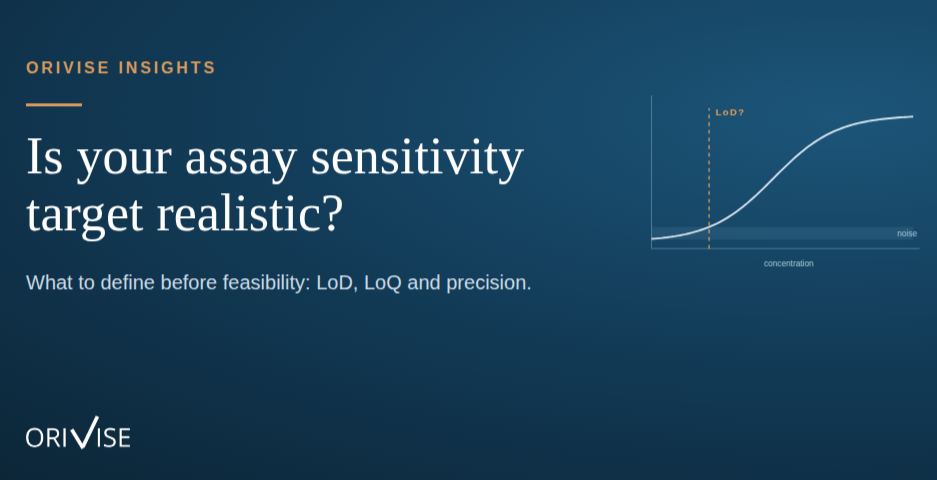
Many diagnostic projects start with a sensitivity target and a promising early signal. The harder question comes later: can the assay reach the limit of detection the product needs, reliably, in real samples? When that question is left open, feasibility data becomes hard to interpret and development decisions drift.
This is especially common with low-abundance biomarkers, where the required sensitivity may sit close to the practical limits of the biology, reagents and platform.
Start from intended use, not from the best result
A sensitivity target should come from the clinical question. Who is tested, in what sample, at what point in the care pathway, and what result changes a decision? From that, define the analytical targets that matter:
Limit of detection (LoD): the lowest concentration the assay can reliably distinguish from a blank.
Limit of quantitation (LoQ) or functional sensitivity: the lowest concentration measured with acceptable precision.
Precision: within-run, between-run and between-lot, at concentrations near the clinical cut-off.
A single strong signal from an optimised run does not answer any of these. It shows the assay can work, not that it works reliably at the level the product needs.
Design feasibility to separate signal from noise
Feasibility studies often use samples that make an assay look better than it is: spiked buffer, a narrow concentration range, or a few well-characterised samples. Useful feasibility work instead:
uses a sample panel that reflects the intended matrix and concentration range, including samples near the cut-off;
repeats measurements across days, operators and reagent lots;
includes true blanks and low-level samples to estimate noise, not just signal;
controls handling and timing, which can quietly add variability that looks like poor sensitivity.
Be ready for an honest answer
Sometimes a well-designed study shows that the original target sits beyond realistic biological or technical limits. That is not a failure. It is the information the team needed before committing development money. The useful outcome is a clear choice: refine the assay towards a realistic target, change the intended use, or pause before costs grow.
Questions to ask before your next feasibility study
Which clinical decision does the result inform, and what concentration matters for it?
Have LoD, LoQ and precision targets been written down and agreed?
Does the sample panel reflect real samples near the cut-off?
Are handling, timing and lot effects controlled or measured?
What result would make you stop, refine or proceed?
If you are working towards a demanding sensitivity target and want an independent view of what your feasibility data supports, contact ORIVISE for a free intro call.
This article is for general technical discussion and is not a substitute for a product-specific assessment.
